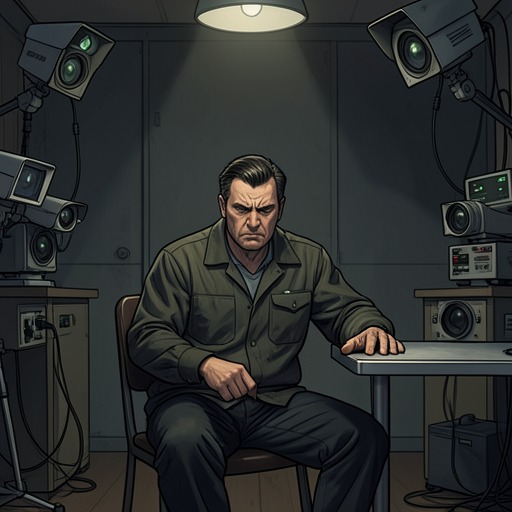
Sleep deprivation as an interrogation method
Guantanamo DiarySleep deprivation as an interrogation method is presented in Guantánamo Diary not as an isolated loss of rest but as a sustained practice joined to control of temperature, activity, and access to ordinary stimuli. Mohamedou Ould Slahi recalls being kept awake for about two months as an interrogator tried to break his mental resistance. The account gives the method a specific purpose and duration, while later government investigations and studies describe why sleep loss can impair a detainee’s ability to withstand isolation and pressure.
Method and Purpose
In Slahi’s account, the interrogator used several measures to prevent sleep: lowering the room temperature, requiring him to write about his life, repeatedly giving him water, and at times making him remain standing through the night. These actions formed a coordinated routine rather than a single episode. The stated aim, as Slahi describes it, was to weaken his resistance; he says the effort did not produce the cooperation the interrogator wanted.
Sleep deprivation also operated alongside other forms of sensory and environmental control. Slahi recalls a separate occasion in a cold room where he was made to listen repeatedly to the national anthem, and describes the interrogator’s broader use of music and restrictions on Islamic practice. These details establish the setting in which sleep was withheld, without making the method reducible to any one accompanying measure. The pressure depended on the cumulative organization of time, temperature, activity, and stimulation.
Effects and Medical Attention
An October 17, 2003, email exchange later documented by the Senate Armed Services Committee provides a contemporaneous reference to Slahi’s condition. An interrogator reported that Slahi was hearing voices and worried because the experience seemed abnormal. The military psychiatrist responded that sensory deprivation can cause hallucinations, while noting that the form they take can vary. The exchange does not by itself establish a complete medical diagnosis, but it records that the reported experience was discussed in connection with deprivation of external stimuli.
Slahi writes that doctors were eventually permitted to see him around March 2004 and that he received psychological assistance for the first time the following month. He says he was prescribed Paxil and Klonopin to help him sleep, as well as a multivitamin for a condition attributed to lack of sun exposure. He also describes sessions with psychologists as helpful, while explaining that he did not tell them the real reason for his illness because he feared retaliation. The sequence marks a change from controlled wakefulness to medical treatment, but does not suggest that the underlying circumstances were immediately disclosed to the clinicians.
Documentary Corroboration and Limits
Slahi’s account is part of a handwritten 466-page manuscript composed in his Guantánamo cell in 2005. The U.S. government later added more than 2,500 redactions, and the editor notes that Slahi could not participate in either stage of editing. Those black bars are not merely gaps in a narrative about interrogation: they register the continuing restrictions on the author and limit what readers can independently establish from the text alone.
The editor’s notes describe an effort to compare the manuscript with publicly available records, including declassified government documents and investigations. In the case of the special interrogation, an investigator working with Stuart Couch obtained access to military interrogators’ files, including daily memoranda describing both sessions and the methods used to obtain information. The underlying files remain classified, but the Senate Armed Services Committee’s 2008 inquiry and a 2008 Justice Department review summarized the interrogation and reported that it unfolded almost as Slahi described. This provides significant corroboration for the broader account of the special interrogation, while the remaining secrecy and redactions counsel against treating every unavailable detail as settled.
Earlier Studies and the Risk of False Confessions
A 1956 CIA study of methods used by Communist state police described loss of sleep as a means of producing fatigue, clouded consciousness, and reduced alertness. It also discussed repeated awakenings, restricted opportunities for sleep, and the use of uncomfortable temperatures. The study characterized these methods as physical coercion even when those applying them might not label them torture. Its appearance in the notes supplies a historical comparison, not evidence that Guantánamo interrogators adopted their practices from that document.
A separate study by U.S. Air Force sociologist Albert Biderman examined how North Korean interrogators had coerced captured U.S. airmen into false confessions. It identified sleep deprivation as a form of debilitation that weakened both mental and physical resistance. Together, these studies frame sleep deprivation as a method with consequences for the reliability of what an interrogated person may say, not simply as a way to extend questioning hours. That distinction matters in Slahi’s case, where interrogators sought cooperation and his account says the sleep deprivation failed to secure the response they wanted.
Narrative and Significance
The method’s significance in Guantánamo Diary lies both in its reported effects and in the record through which those effects become legible. Slahi’s first-person account supplies the duration and practical routine; contemporaneous emails, interrogation files, and later official reviews provide separate points of comparison. The evidence is not interchangeable: an interrogator’s email records a report and a psychiatrist’s response, while the manuscript preserves Slahi’s description of what was done to him. Read together, they show how institutional records can corroborate parts of a detainee’s account without erasing the limits imposed by classification and censorship.
The book’s editorial history reinforces that tension. Its editor describes the annotations as cautious attempts to identify information plausibly corresponding to redactions, not efforts to reconstruct the hidden original or expose classified material. For sleep deprivation, that restraint is essential: the documented methods and reported consequences support a substantial account of coercive practice, but the unavailable files and blacked-out text leave some details unresolved. The subject therefore connects bodily and psychological pressure to a broader problem of evidence: interrogation may be designed to overcome resistance, while the conditions it creates can undermine the reliability of the information it produces.